CAT CARE SERVICES LTD abstract chevron markCat CareServices Ltd

Information technology services

Engineering softwarethat keeps workingafter launch day.

CAT CARE SERVICES LTD designs, builds and maintains digital systems — web and mobile products, cloud platforms, integrations and data pipelines. We work as an engineering partner: clear scope, readable code, documented decisions and a delivery rhythm that a business can plan around.

01
Product engineering
02
Cloud & infrastructure
03
Data & analytics
04
Security & assurance
Software engineers reviewing application code together on large monitors in a modern office
Collaborative engineering — shared context, reviewed changes

An engineering company, organised around delivery.

We are an IT services company. Our work covers the full life of a digital product: understanding the problem, shaping an architecture that fits it, writing and reviewing the code, releasing it safely, and keeping it healthy while requirements evolve.

Engagements are structured around small, focused teams who stay close to the people who use the software. We prefer to reduce a large ambition into deliverable increments, then measure each increment against the outcome it was meant to produce. That keeps decisions reversible and keeps the cost of change low.

We do not sell a fixed methodology. Some systems need strict release governance and formal documentation; others need rapid iteration and short feedback loops. We adapt the process to the constraints of the domain, the regulatory context and the team we work alongside.


Core service categories

Detailed on the Services page

Build

Custom software, web and mobile products

Applications shaped around a specific operational reality rather than a generic template — internal platforms, customer-facing services, mobile clients and the APIs that connect them. We treat maintainability as a functional requirement, not an afterthought.

Run

Cloud and platform work

Environments defined as code, predictable deployments and observability that makes production behaviour legible.

Connect

Systems integration

Contracts between systems, resilient messaging and migration paths away from brittle point-to-point links.

Understand

Design, data and assurance

Interface design grounded in real tasks, data pipelines that produce numbers people can defend, and testing practices that catch regressions before users do.

Where we are usually called in

Common problems behind a request for engineering help

  1. 01

    Delivery has slowed and nobody can say why

    Releases take longer each quarter, small changes trigger unexpected failures, and estimates stop being trusted. Usually the cause is accumulated coupling and missing test coverage rather than team capacity.

  2. 02

    The system cannot absorb a new business requirement

    A product built for one workflow is asked to support several. We look for the seams — where responsibilities can be separated without a rewrite — and sequence the change so the service stays available.

  3. 03

    Infrastructure cost and behaviour are opaque

    Environments drift apart, capacity is guessed at, and incidents are diagnosed by intuition. Codified infrastructure and useful telemetry replace guesswork with evidence.

  4. 04

    Reporting numbers disagree with each other

    Different teams compute the same metric in different places. A defined data model, documented transformations and tested pipelines make a single answer possible.

  5. 05

    Users avoid the software that was built for them

    Adoption problems are frequently design problems. Observing real tasks, simplifying the critical path and removing dead ends usually matters more than adding features.

Software delivery approach

Short cycles, visible state, reversible decisions

Work starts with a discovery pass: the problem, the constraints, the systems already in place and the definition of a successful outcome. That produces a delivery sequence rather than a monolithic specification.

From there, development runs in short increments. Each increment ends with something demonstrable — a working slice, a migration completed, a bottleneck removed — and a written record of the decisions that shaped it. Automated pipelines build, test and deploy every change, so the distance between writing code and validating it stays small.

Architecture is chosen to be reversible where possible. We favour clear boundaries and explicit contracts, because they let a later team replace one part of a system without renegotiating all of it.

  1. Step 01

    Discovery

    Problem framing, constraint mapping, technical review of what exists.

  2. Step 02

    Shaping

    Architecture options, delivery sequence, risks named early.

  3. Step 03

    Increment

    Build, review, automated test, deploy behind controlled release.

  4. Step 04

    Feedback

    Observe real usage, measure against the intended outcome.

  5. Step 05

    Hardening

    Performance, resilience, security review, documentation.

  6. Step 06

    Continuity

    Handover, maintenance rhythm, planned modernisation.

Technology capabilities

Technology choices follow the problem. The list below describes the areas our engineers work in day to day; a specific stack is agreed per engagement, taking into account the skills of the team who will own the system afterwards.

Application engineering

  • Typed backend services
  • Modern component-based front ends
  • REST and event-driven APIs
  • Native and cross-platform mobile clients

Platform and delivery

  • Containerised workloads
  • Infrastructure as code
  • Continuous integration and delivery
  • Environment and release management

Data engineering

  • Relational and analytical stores
  • Batch and streaming pipelines
  • Schema design and modelling
  • Reporting and visualisation layers

Reliability and security

  • Monitoring, logging and tracing
  • Automated test suites
  • Access control and secrets handling
  • Backup and recovery procedures
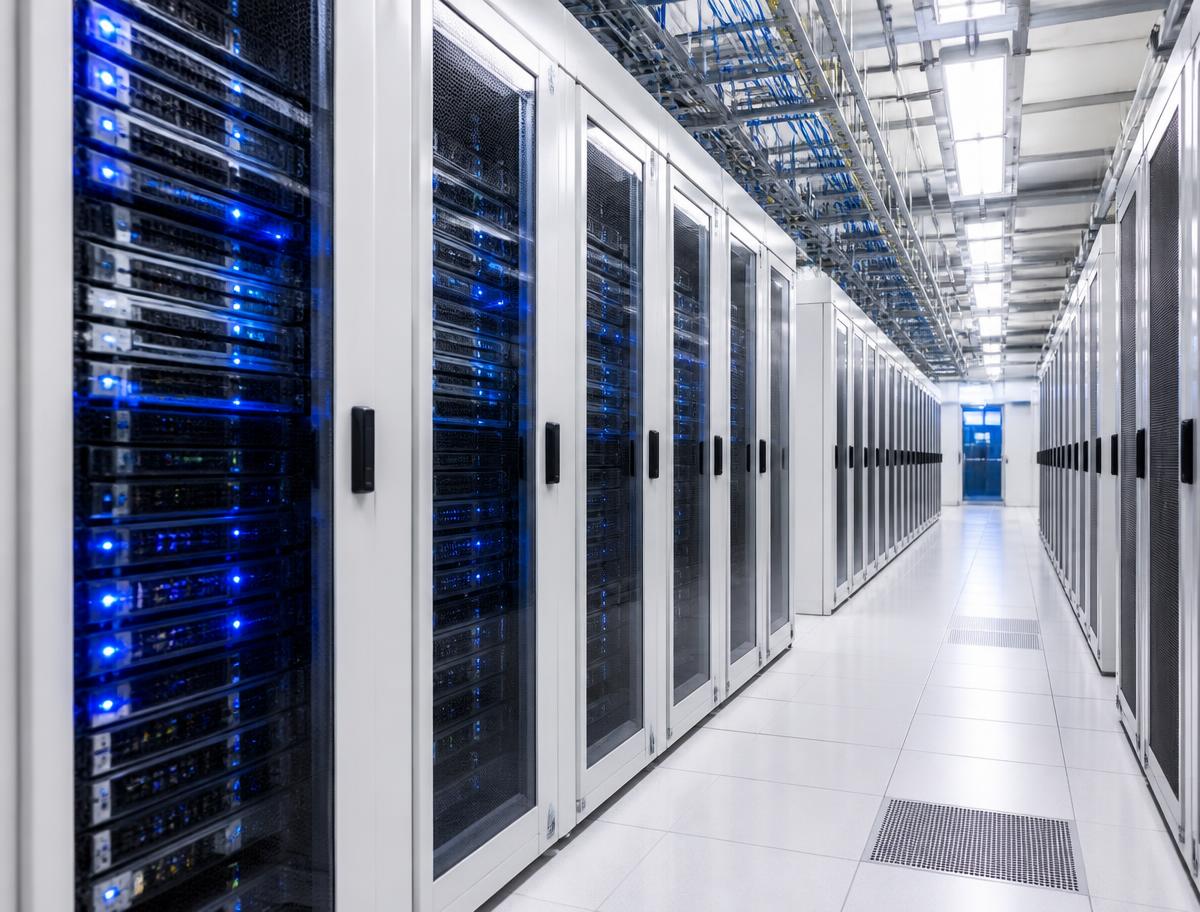
Aisle of server racks with blue status indicators inside a modern data centre

Cloud and infrastructure

Environments that can be rebuilt, not remembered

We define infrastructure in version-controlled code so that staging and production stay comparable and a new environment is a routine operation rather than a project. Deployments run through pipelines with automated checks and a defined rollback path.

Migration work is planned in stages, with the legacy system remaining available until the replacement has proven itself under real traffic. Capacity, cost and failure modes are reviewed together — an architecture that scales but cannot be afforded is not a solution.

Cybersecurity and reliability

Security treated as an engineering practice

Security decisions belong in design reviews, not at the end of a project. We work through threat scenarios relevant to the system, define how identity, authorisation and secrets are handled, and put those rules into code and pipelines where they can be verified automatically.

Reliability follows the same logic. Service behaviour is instrumented, failure modes are named, and recovery procedures are written down and rehearsed rather than improvised during an incident. Dependencies are tracked and updated on a schedule.

  • Access control by default
  • Automated dependency review
  • Documented recovery paths
Laptop displaying encrypted application code in a dark room, illustrating cybersecurity work
Analytics dashboard showing line and bar charts on a dark screen
Reporting layers built on modelled, tested data

Data and analytics

From scattered records to numbers a team can defend

Analytics work begins with definitions. What counts as an active account, a completed order, a resolved case? Once those are agreed, we model the data, build pipelines that transform source records into that model, and test the transformations the same way we test application code.

Reporting is then a thin layer over a dependable foundation — dashboards, exports or embedded views, depending on who needs the answer and how often. Lineage and documentation are part of the deliverable, so a number can always be traced back to its source.

Product design and user experience

Interfaces designed around the work people actually do

Design starts by mapping the task: who performs it, how often, what they already know and where the current process breaks down. From that we produce flows and wireframes that can be reviewed cheaply before any interface is built.

Visual design and interaction detail follow, delivered as a component system shared with engineering so that what is designed is what ships. Accessibility — keyboard operation, contrast, readable structure — is part of the specification rather than a later correction.

Product designers sketching interface wireframes on paper and a tablet

Collaboration

How we work with your team

Our teams integrate with the people who already understand the domain. Communication is deliberate: a shared backlog, written decisions, regular demonstrations and direct access to the engineers doing the work.

Colleagues discussing a project plan next to a wall of sticky notes in a bright office

Shared visibility

One backlog, one definition of done and an open view of progress. Nothing important lives only in a private thread.

Written decisions

Architectural choices and trade-offs are recorded, so the reasoning survives staff changes and long gaps between releases.

Direct contact

The people building the system take part in the conversations about it, which shortens the path from question to answer.

Quality assurance principles

Testing as a design constraint

Code that is hard to test is usually hard to change. We use that as a signal: when writing a test becomes awkward, the structure of the code is examined before the test is forced into place.

Automated coverage is layered — unit tests for logic, integration tests for boundaries, end-to-end checks for the paths a user depends on. Exploratory testing complements the suite where judgement matters more than assertion. Defects are traced to their cause, and the fix includes a test that would have caught them.

Dark data centre corridor lit by amber indicator lighting, representing production infrastructure

Business contexts

Situations our services are designed for

Organisations replacing internal tooling

Spreadsheets and ageing internal applications that have outgrown their original purpose, where the priority is continuity of operations during replacement.

Teams launching a new digital product

Early-stage products that need an architecture able to survive changing requirements without being over-engineered on day one.

Systems that must exchange data reliably

Environments where several applications, suppliers or services need consistent contracts and dependable messaging between them.

Products with meaningful data volumes

Cases where reporting, forecasting or operational analytics need a modelled and tested data foundation instead of ad-hoc extracts.

Software under tightening security expectations

Systems where access control, auditability and dependency hygiene need to be demonstrable rather than assumed.

Long-lived applications needing modernisation

Codebases that still deliver value but have become expensive to change, where incremental refactoring is preferable to a rewrite.

Contact information

Company details

Written enquiries about services, engagement models or technical questions are handled by email. Full details are also listed on the Contacts page.

Company
CAT CARE SERVICES LTD
Email
christineturner19321@gmail.com
Website
felinecarehub.com